
Small-business accounting platforms for US sole proprietors and small corporations are designed to centralize routine bookkeeping tasks—invoice generation, expense capture, bank transaction import, tax-oriented record keeping, and basic reporting—into a single cloud interface. Such systems typically aim to reduce manual data entry by linking to bank accounts, categorizing transactions, and storing digital receipts, so that business owners and accountants can maintain clearer records for federal and state reporting requirements.
Key functionality in these platforms often covers the flow from issuing customer invoices to reconciling received payments and tracking deductible expenses. For US users this also means features that map transactions to forms and categories relevant to federal filing (for example, classifications that support Schedule C or corporate returns) and that accommodate common US payment methods and payroll workflows. Data export and access controls are commonly included to support collaboration with CPAs or tax preparers.
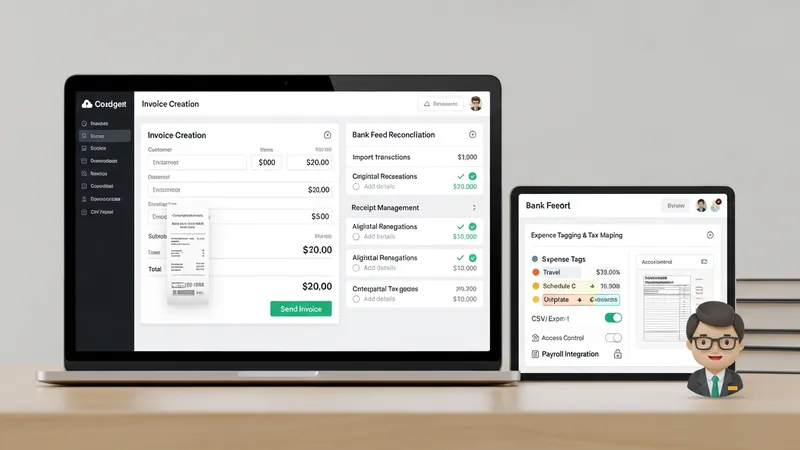
Invoicing and payment-tracking functionality may often include templated invoices, scheduled reminders, and status flags for unpaid items; integration options can vary by provider and may include merchant services commonly used in the US. Expense management features typically allow mobile receipt capture and vendor tagging, enabling a clearer audit trail for deductible items. Bank connection behavior usually adheres to US banking protocols, and reconciliation tools may support manual matching as well as rule-based categorization to reduce repetitive work.
Tax-related record keeping in US-focused accounting tools commonly maps transactions to broadly used filing categories such as business income, cost of goods sold, wages, and contractor payments that feed into 1099 reporting or Schedule C preparation. These platforms often offer export formats or reports designed to assist tax preparers; however, tax filing and liabilities remain the responsibility of the filer. Users and accountants may use these reports to prepare federal and state filings or to calculate estimated tax obligations.
Financial reporting modules typically generate profit-and-loss and balance sheet summaries on demand, and may include cash flow views that summarize inflows and outflows over selectable periods. For many US small businesses, these reports are useful for periodic bookkeeping checks and for discussions with lenders or advisors. Reporting frequency and granularity can often be customized, which may help with monthly closes or quarterly estimated tax planning.
Security and access control are common administrative features: role-based permissions, encrypted data transfer, and export options for long-term archival. For US firms, these controls may be important when sharing records with external accountants or when maintaining records for the IRS retention period. Integrations with payroll or time-tracking systems are often available to reduce duplicate entry for payroll expenses and employee-related reporting.
In summary, cloud accounting platforms intended for small US businesses centralize invoice processing, expense capture, bank reconciliation, tax-oriented record keeping, and foundational reporting to support bookkeeping and tax preparation. Functionality and integrations vary, and configuration typically depends on business type and filing needs. The next sections examine practical components and considerations in more detail.
Invoicing features commonly found in small-business accounting tools include invoice creation templates, customizable fields for US tax identifiers, and status tracking for unpaid items. In the US context, these features may integrate with payment processors (for example, ACH settlement or card processors) so that received payments can be matched automatically. Consideration should be given to how the system records payment dates and fees, since those entries affect net income and bank reconciliation. Businesses that bill recurring clients often evaluate whether the platform supports scheduled invoices and automated reminders to reduce manual follow-up.
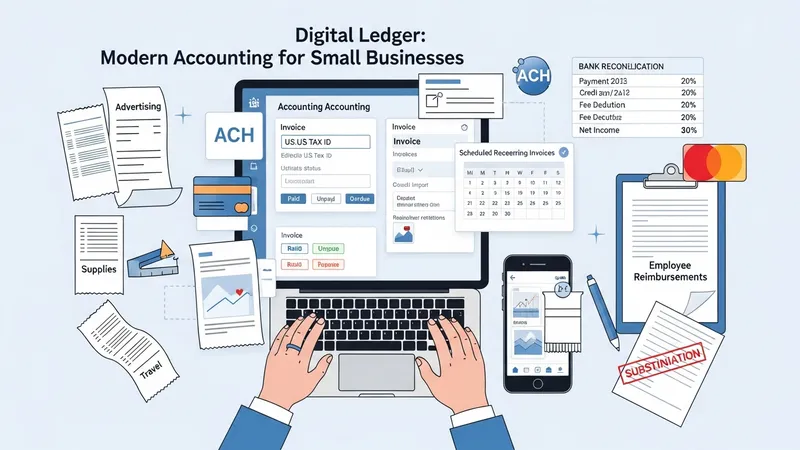
Expense tracking and receipt management typically provide mobile capture, categorization, and vendor tagging. For US taxpayers, categorization that aligns with IRS expense types—such as advertising, supplies, or travel—may simplify year-end reporting. Platforms often include bulk import options for credit card statements and allow attachment of scanned receipts to transactions. As a consideration, users may assess how well an expense workflow supports employee reimbursements and whether it preserves receipts in formats acceptable for IRS substantiation.
Bank transactions and reconciliation features usually rely on secure connections to US financial institutions to import transaction histories. Reconciliation tools may support one-click matching when transaction amounts and dates align and may allow soft-matching rules for recurring payments. For cash-flow accuracy, systems often provide adjustments for uncleared deposits or outstanding checks. A practical consideration is the frequency of bank feed updates and how time-zone differences or posting delays at US banks might affect the apparent cash position.
Reporting and export functions are important for collaboration with US accountants and for tax filing. Common report types include profit and loss, balance sheet, aged receivables, and transaction lists filtered for 1099 vendors. Export options such as CSV or accountant-specific packages may facilitate transfer to tax-preparation software. When choosing settings, owners often weigh the granularity of reporting needed for quarterly estimated tax calculations against the administrative overhead of maintaining multiple reporting views.
Bank connectivity in US-focused tools is often provided via direct bank links, secure aggregation services, or manual import of statements. Each approach has trade-offs: direct links can provide near-real-time transaction flows, while manual imports may be used where direct connections are limited. Transactions imported from US banks should be categorized consistently to support tax reporting and cash-flow analysis. Users may check transaction dates and posting practices at their banks (for example, weekend posting delays) to avoid misinterpreting the business's available cash.
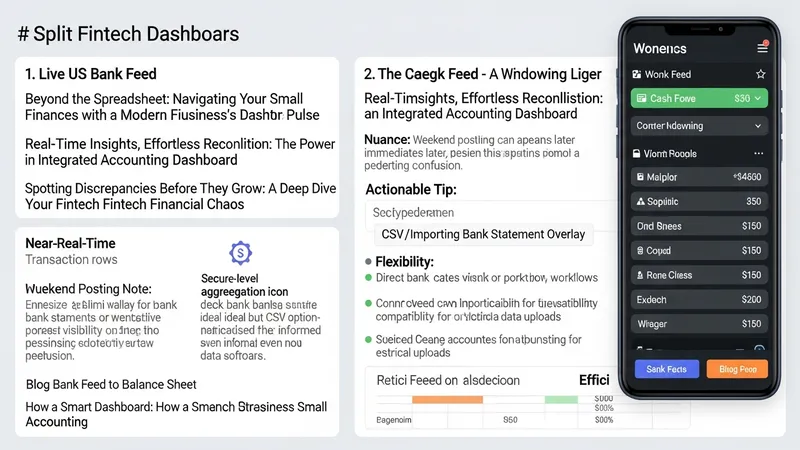
Reconciliation workflows typically compare ledger balances to bank statements and flag discrepancies for investigation. For many US small businesses, reconciliation is a monthly activity that identifies missed entries, duplicated charges, or uncleared items. Reconciliation tools may provide tracing features to see which transactions were matched automatically and which require manual review. A common consideration is maintaining a short reconciliation cadence to reduce the time needed to resolve discrepancies and to preserve an accurate cash picture for payroll and vendor payments.
Cash flow monitoring features often summarize expected inflows from unpaid invoices and outflows from scheduled bills or payroll. For US firms managing seasonal revenue or irregular client payments, projected cash flow reports may help estimate shortfalls or surpluses over a 30–90 day horizon. These projections typically depend on invoice due dates and anticipated vendor payments; users may find it useful to mark invoices with likely collection timing when planning for payroll or tax deposits.
Integration with US payment methods and merchant services can affect reconciliation and bank deposits. For example, card-processing fees and batch settlement timing may create differences between gross invoice amounts and net deposits. Some platforms allow recording processor fees automatically; others require manual fee entry. Accounting administrators often review how fee entries and settlement reports from processors align with bank deposits to ensure accurate net revenue reporting.
Record keeping that supports US federal and state tax filing typically maps transactions to categories used on common returns such as Schedule C, corporate returns, and payroll filings. For contractor payments, tools may offer vendor tracking to facilitate 1099-NEC reporting; for employee wages, integrations with payroll providers may supply wage summaries needed for Form 941 or Form W-2. It is important to maintain supporting documents—receipts, invoices, and contracts—in formats that are accessible for tax preparation and potential review by the IRS or state agencies.

Sales tax and state-level considerations can vary across jurisdictions. Small businesses operating in multiple US states may need to track taxable sales by state and by tax rate, and some accounting platforms provide tax location rules or integrations with sales-tax automation services. Users should treat state registration, filing frequency, and taxability rules as separate administrative obligations; accounting tools may generate reports that summarize taxable transactions but do not replace filing responsibilities with state tax agencies.
Estimated tax planning often relies on periodic profit-and-loss summaries and payment histories. For US sole proprietors and pass-through entities, quarterly estimated tax payments may be calculated from projected net income; accounting reports can support those estimates by aggregating taxable income and withholding status. As a consideration, business owners may export summarized reports for review with a tax professional to confirm estimated payments and to discuss deductions or timing strategies that could affect liabilities.
When working with a CPA or enrolled agent, common practices include granting read-only access or exporting accountant-specific packet files. Export formats that preserve transaction metadata and attached receipts may reduce back-and-forth during tax preparation. In the US, many preparers request transaction detail categorized to IRS expense lines; designing a consistent chart of accounts that aligns with those lines can streamline year-end preparation and reduce adjustment work during filing.
Financial reporting in small-business accounting systems typically includes standard statements—profit and loss, balance sheet, and cash-flow summaries—and supplemental schedules such as aged receivables. For US users, reports that provide date-range filtering and export to CSV or PDF formats are commonly used in monthly closes or when sharing information with lenders and advisors. Administrators may configure report columns and account groupings to reflect the nomenclature needed for internal reviews and for external reporting.
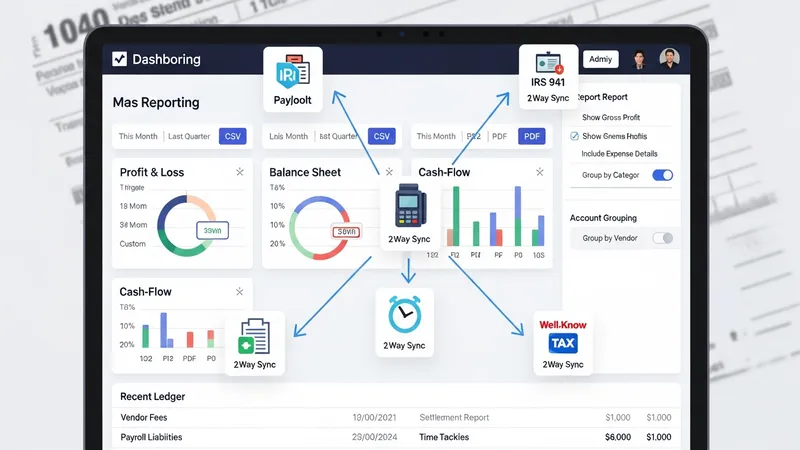
Integrations with third-party services—payroll providers, payment processors, time-tracking tools, and tax software—are often important for reducing duplicate entry. In the US market, common integrations may include payroll services that handle federal payroll tax deposits and filings, and merchant processors that provide settlement reports. When evaluating integrations, administrators typically consider whether synchronization is one-way or two-way and how vendor fees or payroll liabilities are represented in the ledger.
Security and access control features usually include encrypted data transfers, role-based permissions, and audit logs that show changes to transactions and user activity. For US businesses that share financial access with external accountants, read-only user roles or time-limited access are common controls. Data retention and export options may be reviewed against IRS record-retention recommendations to ensure that bookkeeping files remain available for the commonly suggested retention periods.
Administrative considerations include chart-of-accounts setup, user permissions, and month-end procedures. Establishing simple routines—regular categorization rules, periodic reconciliation, and consistent naming conventions—may reduce errors and keep records aligned with US tax filing needs. Ongoing maintenance, including software updates and periodic review of integrations, can help ensure that the accounting environment remains accurate and useful for owners and their advisors.